Restoring Function. Embracing Life.
Dr Bryan Wang
Consultant Orthopaedic Surgeon
Trusted Orthopaedic Surgeon | Fellowship-trained in Canada | With over 20-years of experience
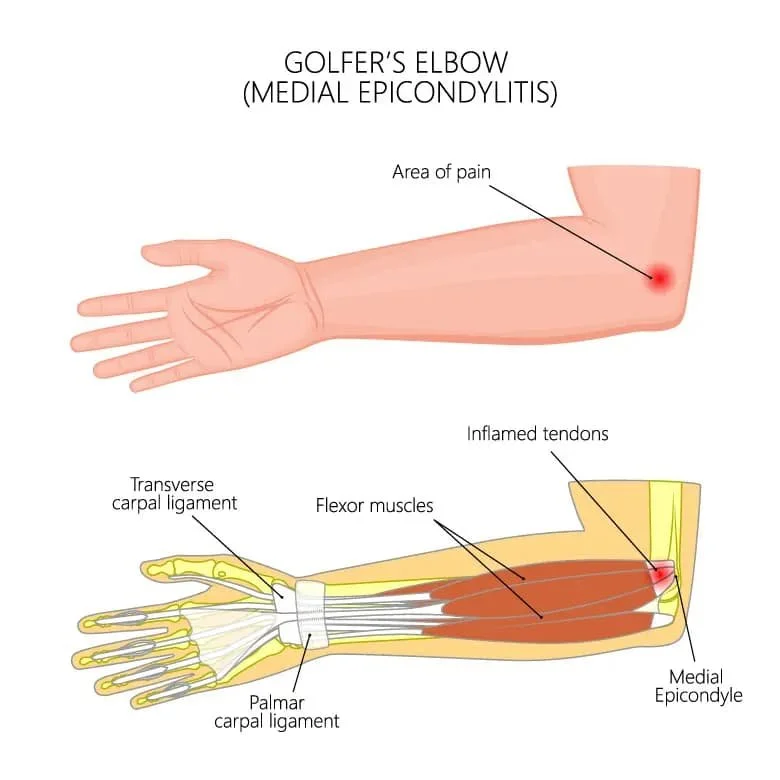
Golfer’s elbow, also known as medial epicondylitis, occurs when there is pain and inflammation over the inner side of the elbow. The pain is caused by damage to the tendons that help with bending of the wrist.
Despite its name, it is not limited to golfers and can occur in anyone who performs repetitive wrist flexion activities. It is caused by repetitive stress from gripping, wrist flexion, or forearm rotation—common in golf, but also in activities like throwing, weightlifting, or even excessive typing.
Some of the common causes include:
Understanding Golfer’s Elbow: Interview with Dr Bryan Wang
Patients typically complain of the following symptoms:
Clinical assessment will include taking a detailed history and a thorough examination of your elbow.
Further imaging tests like X-rays, MRI scans and ultrasound scans may occasionally be required.
Non-surgical measures will usually be recommended first if you have not had any prior treatment for your tennis elbow. Majority of patients do well with non-surgical management.
Rest
Minimise activities which aggravate the pain (sports, manual work, housework)
Ice
Applying ice packs to the elbow for 15-20 minutes 3 to 4 times daily to reduce inflammation.
Physiotherapy
Stretching and strengthening exercises targeting the forearm muscles and tendons can help relieve pain and prevent future injuries.
Medications
Anti-inflammatory drugs to reduce pain and swelling
Brace
Using a brace centred over the back of your forearm may reduce symptoms by resting the muscles and tendons
Cortisone injection
Steroids are very effective anti-inflammatory medicines. This may be necessary if the pain is persistent despite the above measures
Platelet-rich plasma (PRP)
This is a biological treatment designed to improve the biologic environment of the tissue. While some studies about the effectiveness of PRP have been inconclusive, others have shown promising results.
Treatments of Golfer’s Elbow: Interview with Dr Bryan Wang
If your symptoms remain persistent despite all the above measures, surgery may sometimes be required.
Most surgical procedures for golfer’s elbow involve removing the unhealthy tendon, improving the blood supply, and reattaching the healthy tendon back to bone.
The appropriate surgical treatment will depend on the nature of the tear as well as your needs (age, functional demands).
Open surgery
This involves making a small incision over the lateral epicondyle. The unhealthy tendon is removed and the remaining healthy tendons are reattached.
Arthroscopic surgery (keyhole)
This is performed using small incisions and instruments. This is useful when there are other issues within the elbow joint that needs to be treated (ie loose bodies, bone spurs).